



ORTHOLUTION
Next Generation of Orthodontic mini-implant
-
Damage of neighboring soft tissue
- Loosening of the orthodontic implant
- Fracture of the orthodontic implant
- Treatment of the fractured tip
- Injury of periodontal tissue
- Infection and abscess
- Damage of neighboring soft tissue
- Orthodontic implant covered with soft tissue
- Pain during implantation
- Pain during mastication
- Implantation in inappropriate area
Damage of neighboring soft tissue
Damage of neighboring soft tissue
Because of the physical irritation induced by the head of the implant, soft tissue such as the inner side of cheek, may be impaired (figure 11, 12). In particular, the labial mucosa of the six anterior teeth area, where many muscles are distributed, is apt to be impaired (figure 13). In some cases, aphthous ulcerations may arise due to stress during the implantation procedure. Covering the head portion (figure 14) or application of ointment care are appropriate ways to heal the lesions, and in most cases, the lesions heal spontaneously after 1 to 2 weeks.
Fig. 11 After an orthodontic implant was placed, ulcerations resulted in the cheek area due to irritation from the head portion. As with general orthodontic appliances, these problems can also occur from irritation of the orthodontic implant. Therefore, if the orthodontic implant is placed prior to the general orthodontic appliances, such as brackets, the patient should be informed of these side effects in advance.
Fig. 12 Because of the curvature of the alveolar bone surface, an elastic chain can injure the gingival tissue or alveolar bone(a, b, c). Crimpled hooks like a lever arm can reduce the impairment(d).
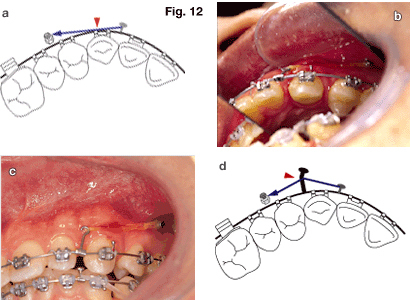
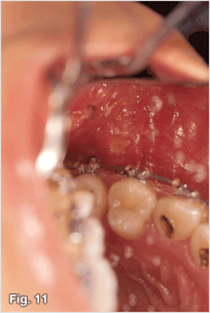
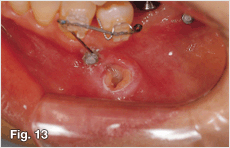
Fig. 13 If exposure of the head portion is large and the muscle activities are high, the impairment area may be larger. In this case, the head portion can be covered with flowable resin to reduce discomfort, or the orthodontic implant must be removed if the patient continues to complain of pain.
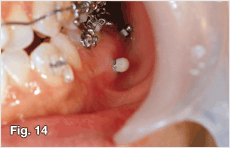
Fig. 14 Covering the head portion with flowable resin reduces patient discomfort. If the flowable resin is to be removed, a high speed engine must be used instead of a low speed engine.
- 상호 : (주)오솔루션
- 대표자 : 김정문
- 주소 : 서울 강동구 양재대로 1371 (성내동) 207호
- TEL : 02-483-1212
- FAX : 02-478-0735
- 사업자 등록번호 : 212-81-63456
- EMAIL : orlus@ortholution.com
- Copyright(c) (주)오솔루션. All Rights Reserved.

