



ORTHOLUTION
Next Generation of Orthodontic mini-implant
-
Sequence of treatment with orthodontic implants
Sequence of treatment with orthodontic implants
Treatment planning
The treatment plan should be determined after the problems, priorities, treatment objectives and cost-benefit analyses have been taken into consideration; this should include the number of implants needed and the insertion sites. The insertion site is selected according to anatomical conditions and biomechanical requirements. Table 4-1 High risk group for implantation of orthodontic mini-implants
- General conditions
- Patients who have artificial organs or artificial valves
- Patients with metabolic bone diseases
- Patients with uncontrolled cardio-vascular problems
- Patients with psychological problems
- Patients with titanium allergies
- Local conditions
- When there is no available space for insertion (for example, root proximity)
- Excessively developed torus
- Where there is mechanical irritation, such as areas near the vestibular fornix
- Where occlusal forces are directly loaded
- Where there is no opposing tooth
Interview, confirmation of the treatment plan, & informed consent
An adequate amount of information should be provided to the patient concerning treatment. And a cost-benefit analysis of implant use, pain and discomfort from implants, possible side effects, and unwanted sequelae should also be presented. It is crucial that the patient makes his/her own choice, and informed consent is required for the purpose of risk management in the event that unwanted results such as loosening occur. The fact that the success rate of orthodontic mini-implants is not 100% must be kept in mind. The success rate of these procedures is higher than 95%, indicating a nearly 5% failure rate.
Patient instructions
- Surgical placement
- It takes about 10 minutes to insert one implant; this does not include time related to anesthesia.
- There is a possibility that a feeling of stiffness will occur in spite of local anesthesia.
- There is a possibility that a feeling of soreness of the teeth will occur despite the fact that the teeth are not touched during the procedure.
- Soft tissue surgery, such as frenectomy, may be indicated in certain conditions.
- The point of implant placement can be modified during the process of an operation according to soft tissue and hard tissue conditions.
- Pain related surgical placement and post-operative discomfort
- There may be pain as the anesthesia wears off and may last for 2-3 days.
- There are many differences among individuals in terms of the perception of pain because pain is highly subjective. Generally, pain from surgical placement of implants can be similar to pain felt after bicuspid extraction or less than this.
- Pain can be significantly reduced by the use of appropriate analgesic agents.
- After implant placement, foreign body sensation from the implant head may result, but will likely relieve itself in 5-7 days.
- Moreover, ulceration may occur due to mechanical irritation or stress from the surgical procedure. This will generally improve in 5~9 days. In the case of ulceration, pain-relieving ointments or ointments containing steroids may be helpful.
-
Unwanted sequelae
- In patients over 15 years of age, loosening of approximately 5~10% may occur; this necessitates re-implantation. In patients under 15 years of age, loosening of approximately 10-20% may occur. Abnormal bone conditions can also have adverse effects on the stability of implants.
- It is possible for implant fracture to occur during insertion in places where bone is extraordinarily hard or accessibility is poor, though this rarely occurs. In case of fracture, additional surgical procedures may be needed or the broken tip could be left behind; this is determined by specific conditions. The surgical procedure of tip-removal should be performed by oral surgeons.
- Additionally, though the occurrence is rare, roots of the adjacent teeth can be injured during surgical placement.
- Although it has never been reported, nerve injury is theoretically possible.
- Inflammation, infection and gingival overgrowth can result if oral hygiene around the implant is not maintained. In the case of gingival overgrowth, an implant seems to be "driven into the gingiva", and a simple operation to reveal the head of the implant may be needed.
- Oral ulceration can also occur due to stress from surgery or mechanical irritation.
-
Post-operative instructions for patients Any kind of mechanical irritation can cause loosening of an implant
- Use prescribed mouth rinses for 2~4 days after the operation, and then brush the area gently.
- Brushing of the implant is also necessary. The soft bristles of a toothbrush should be used to brush as gently as possible, taking care that the head of the toothbrush does not touch the implant. Sonic brushes are not appropriate for cleaning around implants.
- Never touch an implant with a finger or with the tongue. Never rest the tongue on the implant.
- When eating a meal, hard food may cause mechanical irritation, which then leads to loosening.
- An oral irrigator and Rotadent® are good for oral hygiene control.
- An implant is very weak to mechanical shock and thus should be avoided.
- Lying on the side is not recommended. Resting the chin on hands and habitual movement of the cheek is also undesirable.
- Other instructions are the same as those given following periodontal surgery or minor surgery.
-
Emergency The followings are considered emergencies. In the event of an emergency, an immediate visit is recommended.
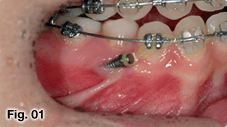
- Marked mobility of an implant means failure.
- An implant can be extruded unexpectedly due to loosening, but this does not cause severe problems. In general, re-implantation is required. Patients should be instructed that this procedure is not to be feared (figure 1).
- Continuous pain over an implant may be a clinical sign indicating latent problems.
- Swelling over an implant or drainage of pus may be a clinical signs of infection.
Fig. 1 An implant showed like extrusion when it became loose.
- 상호 : (주)오솔루션
- 대표자 : 김정문
- 주소 : 서울 강동구 양재대로 1371 (성내동) 207호
- TEL : 02-483-1212
- FAX : 02-478-0735
- 사업자 등록번호 : 212-81-63456
- EMAIL : orlus@ortholution.com
- Copyright(c) (주)오솔루션. All Rights Reserved.

