



ORTHOLUTION
Next Generation of Orthodontic mini-implant
ORLUS Classic
이 제품은 "의료기기" 이며, "사용상의 주의사항" 과 "사용방법"을 잘 읽고 사용하십시오.
* 악안면성형용나사 - 심의번호 2013-I10-02-1059
Characteristics
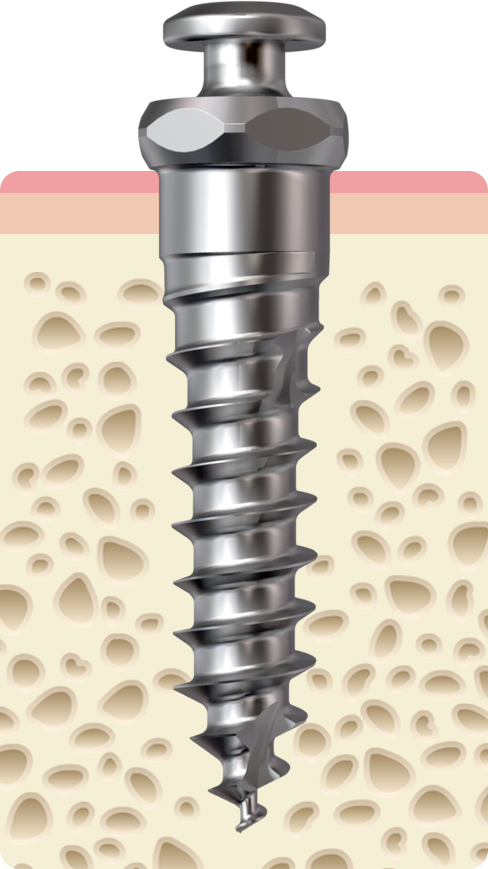
Description
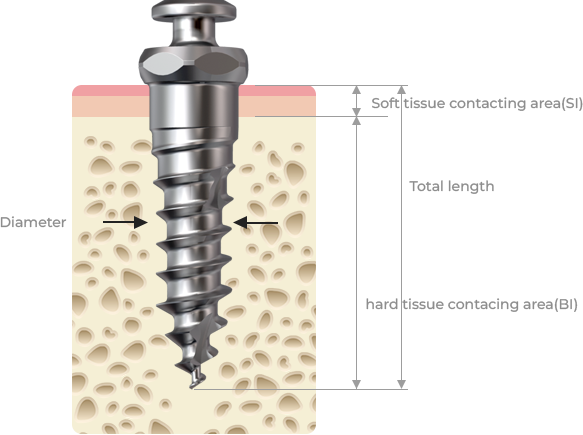
Implant is divided into two parts, SI and BI.
SI is the part contacting soft tissue and BI is in contact with alveolar bone or hard tissue.
The system is designed for easy of insertion anywhere in the oral cavity.
Implant selection depends on soft tissue thickness and bone quality.
Thicker soft tissue will require longer SI.
The ORLUS orthodontic mini-implant is designed for enhanced stability based on scientific research.
-
Histologic studies in beagle dogs and New Zealand white rabbits For stability, good healing and maintenance of the osseous interface are necessary.
-
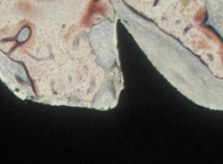
Fibrous interface
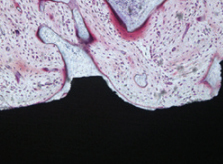
Osseous interface
-
Contact non-linear analyses using two-dimensional models According to finite element model analysis, both thread design and screw diameter are important for initial stability in the cortical bone.
-
Overall effects of screw parameters on stress distribution
 1.4
1.4 1.6
1.6 2.2
2.2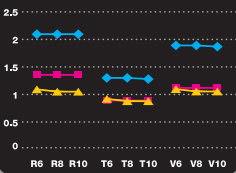
Stress distribution in the cortical bone
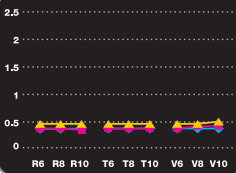
Stress distribution in the trabecular bone
-
Contact non-linear analyses using three-dimensional models stress is concentrated on the pressure side of the cortical bone.
Trapezoid threads are superior from the standpoint of the stress distribution. -
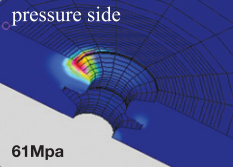
1.4mm in diameter, 6.0mm in length, Trapezoid thread, 200gm of loading
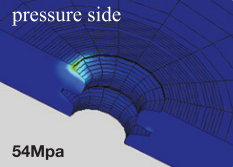
1.8mm in diameter, 6.0mm in length, Trapezoid thread, 400gm of loading
Simple to use & a wide variety of applications.
Pre-drilling and making a flap is not necessary.
There is no problem width immediate loading of the implant
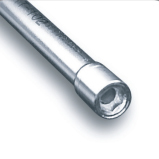
- A hexagonal female driver tip makes the handling efficient and easy.
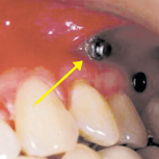
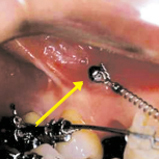
- The implant is stable not only in the attached gingival, but also in the oral mucosa.
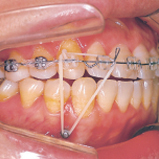
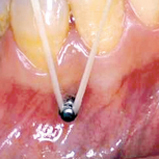
- In addition to intra-arch applications, inter-arch elastic applications are also practical.
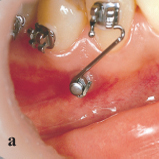
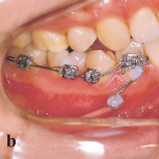
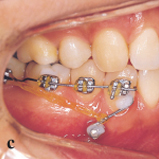
- There is a .022 gap between button head and hexagonal body. ; this provides space for placement of an orthodontic wire (a). The wire can be attached to the implant and tooth width flowable composite(b), giving the individual tooth three-dimensitional anchorage (c).
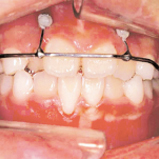
- Using the same method shown in previous figures, the implant can be attached to a labiolingual appliance for maxillary protraction.
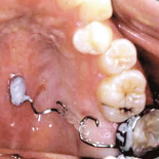
- An extension arm is bonded to ORLUS implants for correction of scissor bite.
- Anterior corssbite was corrected by growth modification, but slight relapse occirred by late mandibular growth. For active retention, implants were placed between the lower 2nd bicuspid and 1st molar, and clear aligner with hook was used at night. Elastics were also used from implants.
Specifications and system components
- The ORLUS mini-implants are available in long and regular length.
- The ORLUS mini-implants are also available in mini, regular and wide diameter.
- An appropriate mini-implant can be selected based on soft and hard tissue conditions at the placement site.
According to hard tissue conditions
-
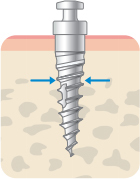
Mini type The mini type is used in places whrer abundant space is not available, such as at the anterior alveolus.
1.4mm -
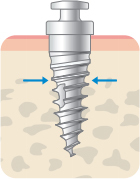
Wide type The wide type is used in general areas and in areas of inadequate bone quality.
1.8mm -
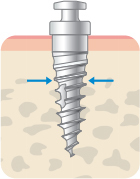
Regular type The regular type is used in general areas where the bone quality is adequate.
1.6mm -
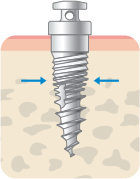
E T type The E T type is used in general areas or lower posterior areas where the bone quality is too dense.
1.6mm / 1.8mm
According to soft tissue conditions
-
Regular type A screw length of 5mm with pre-drilling and 6mm without pre-drilling is usually sufficient for the bone contact.
-
Long type The long type is designed for sites where the soft tissue is thick such as palatal alveolus area.
This type can also be used in areas of unattached gingival, reducing the likelihood of soft tissue overgrowth.
1. For direct implantation : Driver tip (OS-DRT-102) / Driver handle (OS-DRH-01)
2. For indirect implantation : Driver tip (OS-DRT-E01 / E02)
3. ORLUS surgical drill system
The ORLUS mini-implant can be placed without-pre-drilling. But, to decrease surgical trauma during implantation and to prevent root injuries, a manual pilot drill system have been developed.
- The manual ORLUS surgical pilot drill for the hand-driver (OS-DRL-H116)
- The regular ORLUS surgical pilot drill for the contra angle (with dental notch) for palatal alveolus (OS-DRL-E161)
- The long ORLUS surgical pilot drill for the contra angle (with dental notch) for midpalate (OS-DRL-E162)
4. NiTi closed coil spring for ORLUS implant
The size of the mini-implant head is designed for elastic chains.
And NiTi coil spring designed for mini-implants with bigger hole can be used.
ORLUS CLASSIC
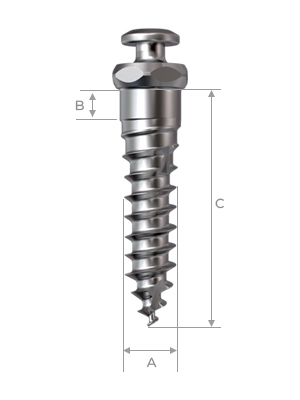
| A | B | C | ||
|---|---|---|---|---|
| 1O14106 | 1.4mm | 1mm | 6mm | Anterior alveolus |
| 1O14107 | 1.4mm | 1mm | 7mm | |
| 1O16106 | 1.6mm | 1mm | 6mm | Mx/Mn labial area Mx/Mn buccal area Midpalatal area |
| 1O16107 | 1.6mm | 1mm | 7mm | |
| 1O16108 | 1.6mm | 1mm | 8mm | Mx/Mn buccal area |
| 1O16208 | 1.6mm | 2mm | 8mm | Buccal shelf, Retromolar area Palatal alveolus area |
| 1O16208 | 1.6mm | 2mm | 8mm | Buccal shelf, Retromolar area Palatal alveolus area |
| 1O18106 | 1.8mm | 1mm | 6mm | Mx/Mn buccal area Midpalatal area |
| 1O18107 | 1.8mm | 1mm | 7mm | Mx/Mn Buccal area |
| 1O18108 | 1.8mm | 1mm | 8mm | |
| 1O18208 | 1.8mm | 2mm | 8mm | Buccal shelf, Retromolar area Palatal alveolus area |
| 1O18309 | 1.8mm | 3mm | 9mm | For 3~4mm thick soft tissue palatal area |
| 1O18410 | 1.8mm | 4mm | 10mm | For 4~5mm thick soft tissue palatal area |
| 1O18511 | 1.8mm | 5mm | 11mm | For 5~6mm thick soft tissue palatal area |
ORLUS E T
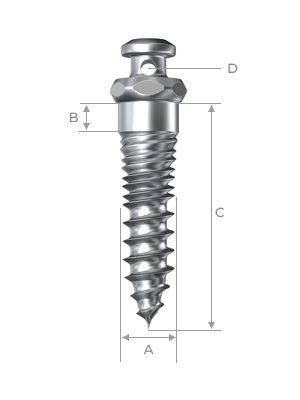
| A | B | C | D | ||
|---|---|---|---|---|---|
| 1T16107 | 1.6mm | 1mm | 7mm | Φ0.6mm | Mn labial area Mn buccal area |
| 1T16108 | 1.6mm | 1mm | 8mm | Φ0.6mm | |
| 1T18107 | 1.8mm | 1mm | 7mm | Φ0.6mm | |
| 1T18108 | 1.8mm | 1mm | 8mm | Φ0.6mm |
ORLUS SURGICAL INSTROUMENTS
-
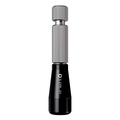
- OS-DRH-01 Standard hand driver handle
-
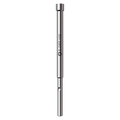
- OS-DRT-102 Standard hand driver tip
-
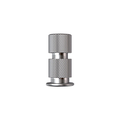
- OS-DRH-02 Small hand driver
-
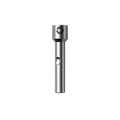
- OS-DRT-201 Small hand driver tip
-
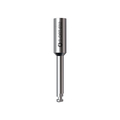
- OS-DRT-E02 Long engine driver tip
-
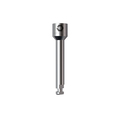
- OS-DRT-E01 Short engine driver tip
-
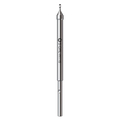
- OS-DRL-H116 pilot drill (standard hand drill)
-
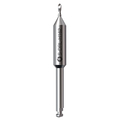
- OS-DRL-E162 Pilot drill (long engine drill)
-
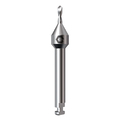
- OS-DRL-E161 Pilot drill (short engine drill)
-
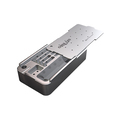
- Container Strorage for sterilization
-
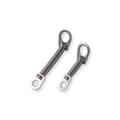
-
Ni-Ti closed coil spring
OS008(L,M,H)
OS013(L,M,H)
-
Ni-Ti closed coil spring
OS008(L,M,H)
- 상호 : (주)오솔루션
- 대표자 : 김정문
- 주소 : 서울 강동구 양재대로 1371 (성내동) 207호
- TEL : 02-483-1212
- FAX : 02-478-0735
- 사업자 등록번호 : 212-81-63456
- EMAIL : orlus@ortholution.com
- Copyright(c) (주)오솔루션. All Rights Reserved.

